
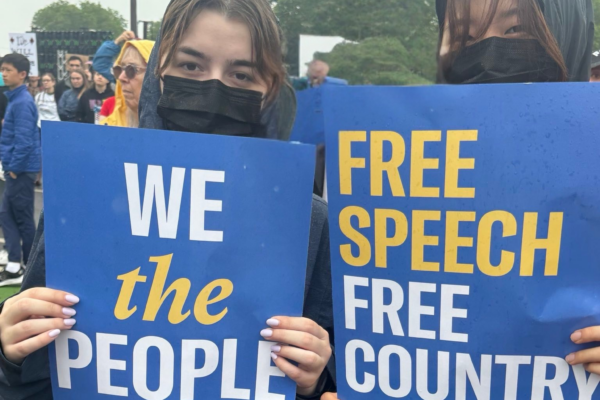


For decades, students have organized school walkouts to protest injustice and to demand policy change, including within their own schools.
Students in public schools do not lose their First Amendment free-speech rights when they go to school. But those rights are more limited than they would be outside of school. That’s largely to allow the school to operate in an orderly fashion.
Over the years, courts have established fairly clear rules for what, when, where and how you can exercise your speech rights in school. Generally, you have the right to speak out as long as you do not disrupt school operations. Students have the right to distribute flyers and petitions and wear expressive clothing in school. And these rights apply even when you are speaking about controversial topics or protesting the school’s own policies and actions.
The school can also require you to follow content-neutral policies, or rules that have nothing to do with messages you express. Examples of these “content-neutral” rules include dress codes, restrictions on leaving the school without permission, and rules prohibiting posting anything on the walls. So, for example, a school can prohibit all students from wearing baseball caps, but if it allows baseball caps, it can’t prohibit you from wearing a cap based on the message it conveys. And a school can punish you for disrupting class by speaking out of turn or leaving the building without a pass, even if you were speaking out of turn or leaving the building in order to make a political statement.
School responses to student walkouts, including the anti-ICE demonstrations, may or may not be unconstitutional, depending on the specific facts. Your decision to participate in a student walkout is up to you. Dr. Martin Luther King Jr. once said that he would accept “the penalty of imprisonment in order to arouse the conscience of the community.” It is up to every individual person to evaluate the potential benefits and consequences to an act of civil disobedience, such as a walkout.
Here’s some guidance on the legality of different types of school responses to student walkouts:
1. If students who participated in a walkout were given the SAME punishment they would have gotten if they left class without permission for any other reason (like cutting class): This is allowable. If your school normally doesn’t allow you to leave the building without permission, then you don’t have any special right to do so to engage in a political demonstration. But just because the school is authorized to punish you doesn’t mean they have to, so it’s worth asking for an exception.
2. If students who participated in a walkout were punished MORE SEVERELY than if they had left for any other reason: This may be illegal. The ACLU-PA believes that it violates the First Amendment for schools to impose harsher punishment on students who leave class to engage in political activities than on those who cut class for any other reason. If you believe this happened to you, please let us know so we can gather more information.
3. If student organizers were punished more severely than other participants: This may be illegal. The ACLU-PA does not believe schools can punish students who helped organize a walkout more severely than other participants in the walkout simply because of their leadership role. If this happened to you, please let us know so we can gather more information.
4. If the school punishes students who walk out to protest the school’s own policies or practices more severely than students who walk out for other reasons: This may be illegal. The ACLU-PA does not believe schools can punish their critics more severely merely because they are criticizing the school. If you believe you were punished unfairly because of your criticism of the school, please let us know so we can gather more information.
5. If teachers blocked students from leaving class or leaving the building, so students did not get to participate in the walkout the way they wanted: This is probably allowable. Most schools have rules that prohibit students from leaving class or the building without permission. If the school knows you are going to violate this or any other rule, they may take reasonable steps to prevent the rule violation. But this doesn’t mean that the school’s decision to prevent students from protesting was a wise one. You have the right to criticize the school’s actions in preventing you from participating in a walkout, including by talking to the media, using your own time and resources when you are not at school. Also, if your parent had already signed you out of school and you had permission to leave and you were still blocked from leaving, please let us know.
6. If students were not allowed to carry any signs during the walkout: Generally, students should be allowed to have signs, as long as they aren’t too big or otherwise displayed in a way that disrupts school operations or violates content-neutral rules, like rules against posting signs on the walls. If you were prohibited from displaying a sign, please let us know so we can gather more information.
7. If the school allowed students to walk out of class and gather somewhere inside the school to protest (like the gym or cafeteria) but punished students who walked out of school: This is probably allowable. Presumably, your school has rules against walking out of class before it ends, or leaving the school, without permission. Just because they chose to relax the rules to allow you to attend a school-sponsored demonstration doesn’t mean they have to relax the rule about leaving the building. If you walked out against the rules, the school is authorized to punish you in the same way they would if you cut class.
8. If only students with parental permission could participate in the walkout without discipline: This is probably allowable. Schools can choose not to punish students who leave class or leave the building with their parents’ permission while punishing students who do so without permission. This especially makes sense when it comes to leaving the building during the day because, if something happened to you while you were in the school’s care, your parents might be able to hold the school responsible.
9. If the school prohibited students from demonstrating on school property following a walkout: This is probably allowable. Schools can prohibit students from holding demonstrations on school property during the school day if they are likely to cause a material and substantial disruption.
10. If the school punished you for what you said or did off school grounds during the walkout, not for leaving school: This may be illegal. Schools have very limited authority under the First Amendment to punish students for their speech outside of school. And Pennsylvania law limits schools’ authority to punish students for conduct that takes places outside of school. If you were punished by your school for your off-campus speech, whether online or as part of a public demonstration, please let us know so we can gather more information. For information about your right to protest off-campus, click here.
11. If teachers are disciplined for helping students organize walkouts: This is probably allowable. Schools can discipline teachers who participate in, help organize or encourage student participation in student walkouts. Teachers have limited free-speech rights when they are acting in their capacity as school employees. If you are a public school teacher disciplined for your involvement in a student walkout, you should contact your union.
You can learn more about students’ free-speech rights and the right to protest in the ACLU of Pennsylvania’s Students' Rights Handbook. The free expression section starts on page 6. This guidance is not a substitute for individualized legal advice, so always consult a lawyer to determine whether your rights have been violated. You can contact the ACLU of Pennsylvania, including to file a complaint or ask a question about your situation, by visiting our “File A Complaint” webpage.