
Kitzmiller v. Dover Area School District – A 20-year Retrospective on Using the Law to Defend Scientific Integrity

by Witold Walczak
With vaccine and climate change skepticism on the rise, it’s important to remember a critical victory for science in U.S. courts. Twenty years ago, in December of 2005, a federal court in Pennsylvania issued a ruling in Kitzmiller v. Dover Area School District that an effort to teach so-called Intelligent Design Creationism as an alternative to evolution in public schools was an unconstitutional endorsement of religion. Intelligent Design Creationists believe that life on Earth is too complex to be a result of the theory of evolution and instead must be the product of an intelligent, supernatural creator. The decision was widely covered both nationally and internationally, and was a significant win for science and the First Amendment.
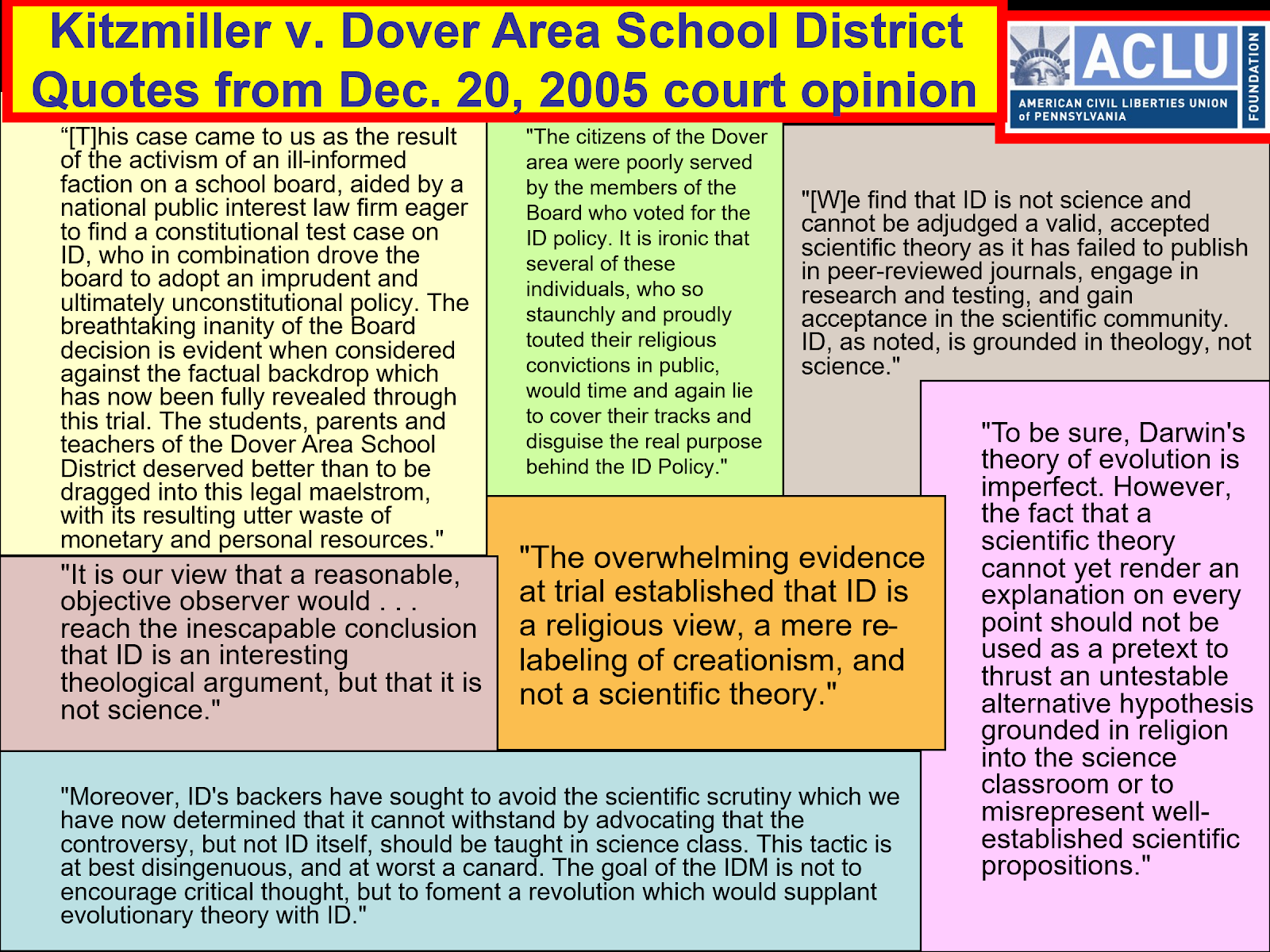
In a 139-page opinion, a relatively new, Republican-appointed judge gave a master class in the basics of science, biology, and evolution in order to show that Intelligent Design was not science, but a religious view. He also excoriated the local school board for deceiving their constituents and repeatedly lying to justify their duplicity.
While the decision didn’t eliminate the Intelligent Design movement, it effectively stopped other public schools nationwide from trying to inject it into the science curriculum. However, the same anti-science sentiments behind the Intelligent Design movement are on the rise again in the age of Trump. With the hope we might learn important lessons for today’s struggle, here’s a walk down memory lane of Kitzmiller v. Dover Area School District.
In the Beginning
The story begins in a small south central Pennsylvania school district. In June 2004, the Dover School Board began discussing at public meetings the need to replace the current biology textbook. School text books need periodic replacement to stay current, and that’s doubly true for science texts. The board’s curriculum chair criticized the current book for being, “laced with Darwinism” (and I’m pretty sure the authors would plead guilty as charged).
In October 2004, the board passed a resolution directing the introduction of Intelligent Design into the biology curriculum, becoming the first public school district in the country to do so (a West Virginia board thought about it a few months earlier but shrewdly rejected it).
The decision splintered the board and the community. Biology teachers, working with their union, objected strenuously. One board member stormed out of a November meeting with this memorable quote:
I was referred to as unpatriotic, and my religious beliefs were questioned. I served in the U.S. Army for 11 years and six years on this board. Seventeen years of my life have been devoted to public service, and my religion is personal. It's between me, God, and my pastor.
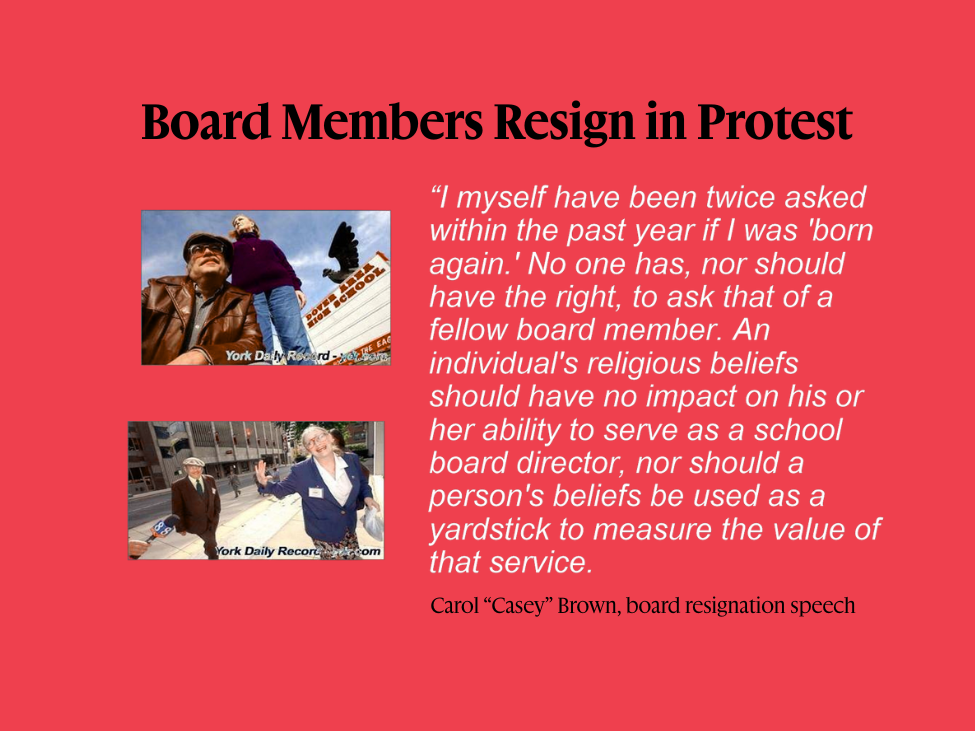
Several other board members resigned, criticizing their colleagues for setting a religious purity test.
The Lawsuit
On December 14, 2004, the ACLU of Pennsylvania, along with co-counsel from Americans United for Separation of Church and State and the pro bono law firm, Pepper Hamilton, LLP, sued the Dover School Board on behalf of 11 courageous Dover parents and their seven children, all students in the district. Our friends at the National Center for Science Education provided invaluable behind-the-scenes support, primarily to identify expert witnesses, help frame the case presentation, and to educate us lawyers on the relevant science and Intelligent Design creationism itself.
The parents’ – now plaintiffs – concerns were threefold: 1) religion is personal, to be directed by family, not school (many of these families were deeply religious); 2) Intelligent Design promotes a view of God different than what they teach their children; and 3) teaching Intelligent as a scientific alternative to evolution misleads students about how science works and about scientific support for evolution. Their legal claim was grounded in the argument that:
“[i]ntelligent design is a non-scientific argument or assertion, made in opposition to the scientific theory of evolution, that an intelligent, supernatural actor has intervened in the history of life, and that life ‘owes its origin to a master intellect. . . .’ Unlike the theory of evolution, however, intelligent design is neither scientific nor a theory in the scientific sense; it is an inherently religious argument or assertion that falls outside the realm of science.”
As preparation work for the lawsuit began, we learned very quickly in the case that the board’s endorsement of Intelligent Design was, at best, hollow. Within weeks of filing the suit, on a snowy January 2005, morning, we had our first encounter with leaders of the Dover School District. We deposed three board members and the superintendent. An important question was, what is this thing called Intelligent Design that you were willing to get sued for. The answers were . . . interesting. Public officials (and their allies) pushing ideas and agendas they can’t fully explain has, tragically, become more prevalent today, but at the time we were astounded.
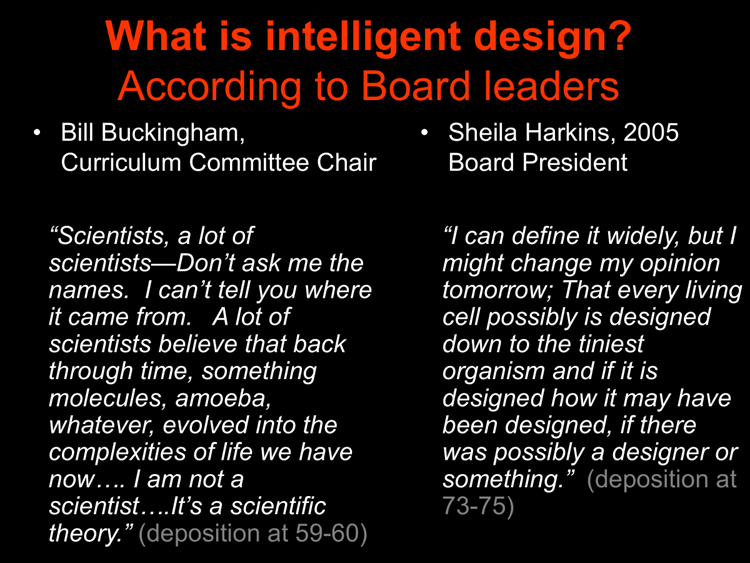
The next eight months were what is regularly the commercial break in network television legal dramas. It’s when the most important case development and trial preparation gets done, but it’s pretty boring for the viewer. During this time we took and defended countless depositions of experts and parties, investigated the origins of Intelligent Design, and built a team of experts that we hoped would reveal Intelligent Design to be a religious idea, and not a scientific view that may constitutionally be taught in public school biology classes.
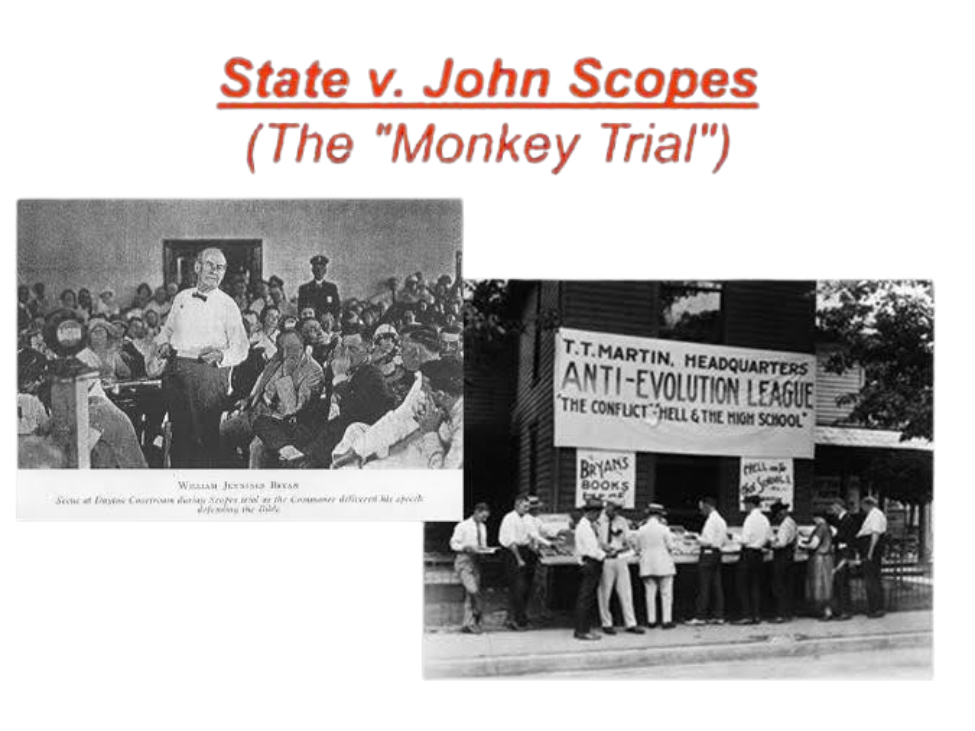
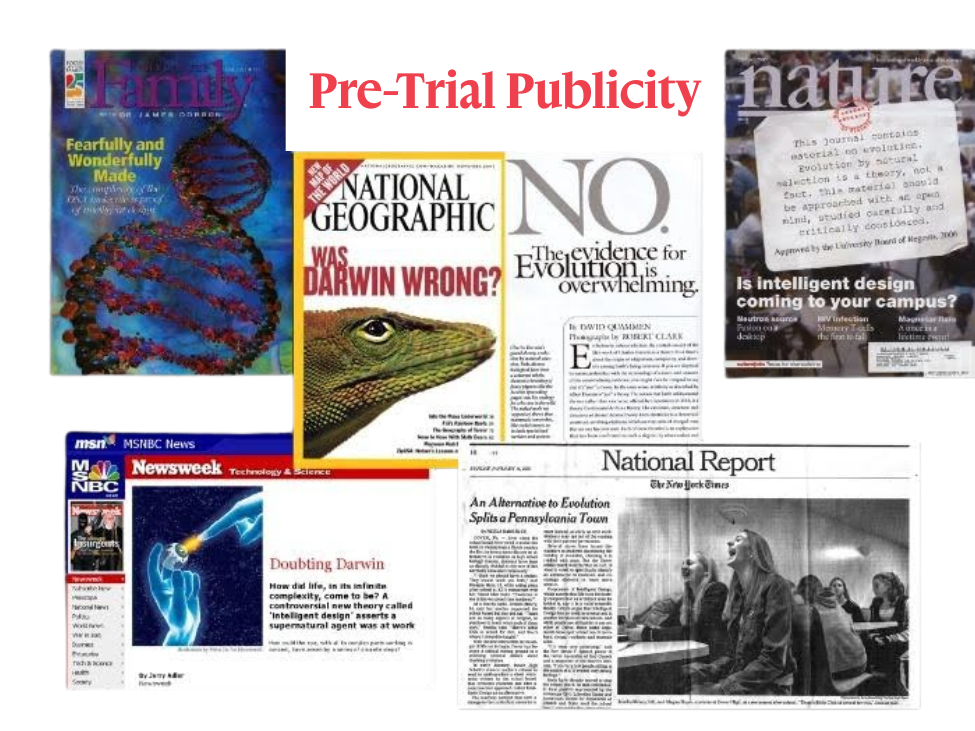
As we got into the summer, and the late-September trial start date came into view, public attention soared. It didn’t hurt that it was the 80th anniversary of the famous Scopes monkey trial, in which Tennessee prosecuted a public school teacher for the crime of teaching evolution instead of creationism. The courtroom battle between attorneys Clarence Darrow and William Jennings Bryan was memorialized in a famous movie, Inherit the Wind. Pundits had started calling our case, Scopes 2! The pre-trial publicity on the case became intense.
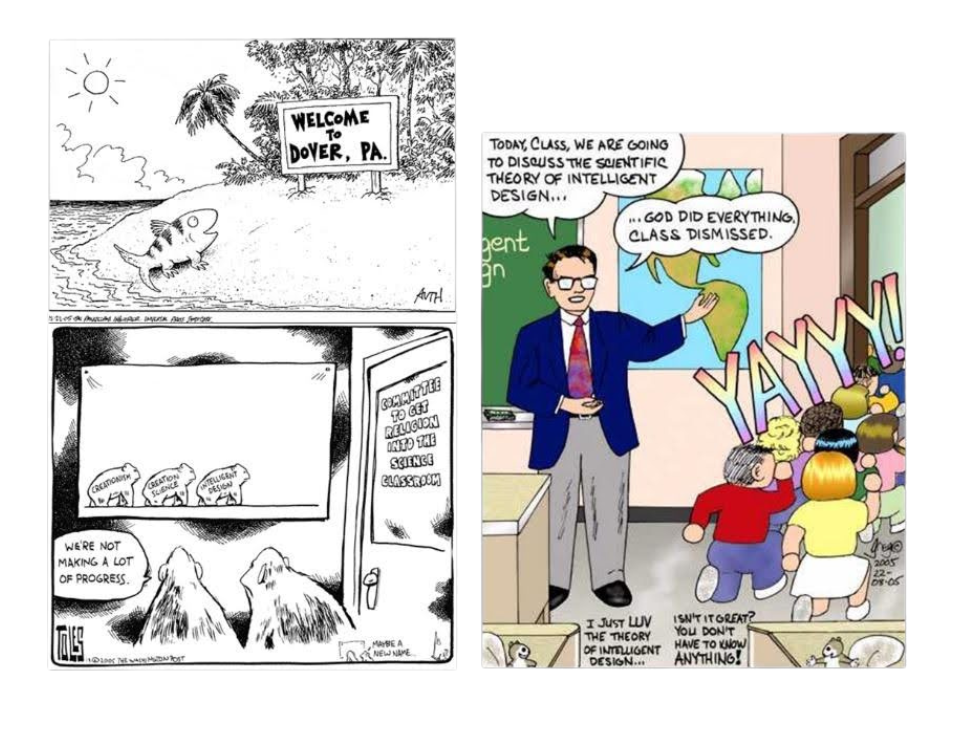
You know it’s big when there are editorial cartoons!
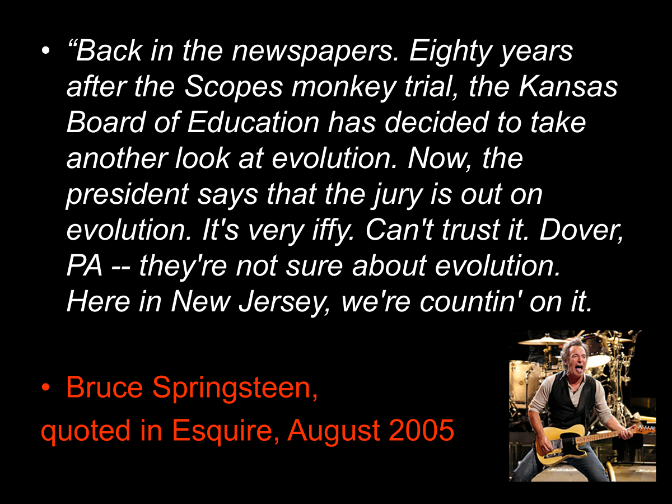
And, it certainly doesn’t hurt to have the Boss talking about the upcoming trial in concert and in print.
The Trial
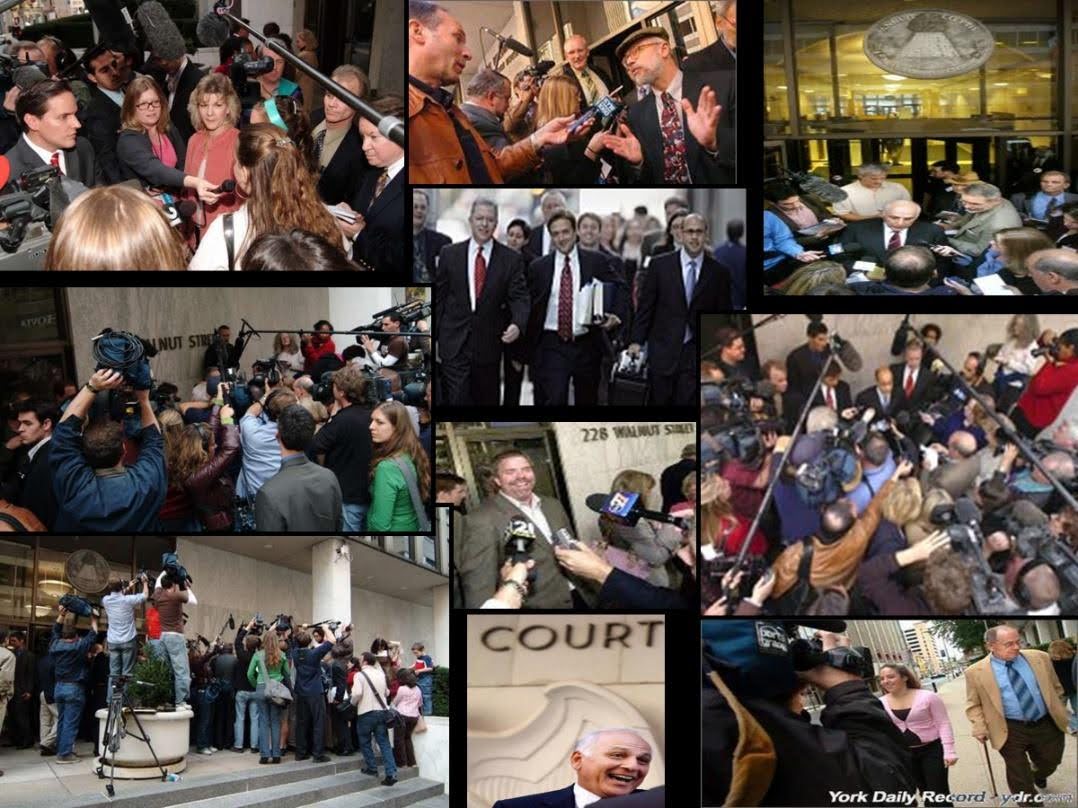
The trial, which was litigated over six weeks, began in late September 2025. An affable newish federal judge, appointed by President George W. Bush, presided. This was a bench trial, which means there was no jury. Given the massive press interest, the judge set aside a separate courtroom with internal video feed for overflow reporters. In the weeks before the trial, the judge denied two efforts by Court TV to broadcast gavel-to-gavel coverage. And both courtrooms were packed. It was a media frenzy.
Since our team represented the plaintiffs challenging the constitutionality of teaching Intelligent Design in public school science classrooms, we went first. Our strategy was to put Intelligent Design under a microscope. Legislative bodies and school boards in Ohio and Kansas had held public hearings on Intelligent Design, with dueling experts leaving people with little clarity. But in a court of law, regulated by rules of evidence and the ability to force people to answer questions under oath, we hoped for a clearer verdict.
We decided to look at Intelligent Design from six perspectives: evolutionary biology, paleontology, science education, philosophy of science, theology, and history of the Intelligent Design movement. We expected to show that regardless of the lens through which one viewed Intelligent Design, it was not science, but a religious idea. By all accounts, and especially by the judge’s account, we succeeded spectacularly.
The Witnesses
Our first witness was Brown Biology professor, Dr. Kenneth Miller. Dr. Miller’s task was huge. We had no indication that the judge had a science background, so the presentation needed to be tailored accordingly. If we wanted to show Intelligent Design is not science, we had to explain science, biology, evolution, etc. Using a PowerPoint months in the making, Dr. Miller testified about how scientists work through observation, research, experimentation, publication and peer review. He also explained how evolution is the unifying principle of biology and every day modern discoveries build on the theory. He talked about how every major scientific association endorsed evolution, but not Intelligent Design. And, he began our dissection of Intelligent Design to show that it might be a very nice idea, but it did not meet the ground rules of science. As one prominent national journalist put it, the trial, and especially Dr. Miller’s (and Kevin Padian’s) testimony were the science class you always wish you could have taken.
Dr. Miller’s conclusion about why teaching Intelligent Design as science in public schools was harmful: 1) it falsely undermines the scientific status of evolutionary theory and gives students a false understanding of science; 2) It suggests to students that there is a “God-friendly” theory, intelligent design, and an atheistic one, evolution. It tells students to choose God on the side of intelligent design or to choose atheism on the side of science; and 3) It injects religious conflict into science classrooms where it does not belong.
Dr. Robert Pennock testified about how Intelligent Design is not, and cannot be, science. Since the scientific revolution of the 16th and 17th centuries, science has been limited to the search for natural causes to explain natural phenomena, not the appeal to any authority, ecclesiastical or otherwise. This dedication to empirical, observable, testable evidence is known as methodological naturalism and is a self-imposed rule of science. We would have to change the ground rules of science, as practiced for the past 500 years, to include Intelligent Design.
Dr. John Haught presented a theologian’s view of Intelligent Design. He noted that Intelligent Design is not a new scientific argument, but identical to an old religious argument for the existence of God, going back to Thomas Aquinas in the 13th century and Rev. William Paley in the 19th century (i.e. if it looks designed, like a watch, then it must have been designed). He also testified that Intelligent Design is not only a religious idea, but presents a particular religious view of God, one that is not accepted by everyone, including, for instance, Catholics.
Professor Brian Alters testified that teaching Intelligent Design as science undermines students’ belief in evolution. Teaching that intelligent design and supernatural causation are scientific is misleading. It engenders misconceptions in students and thus is poor pedagogy. No major, secular-university science departments teach intelligent design, and as a result, Dover was poorly preparing its students.
Paleontologist Kevin Padian was our second scientific expert. Dr. Padian had the task of sealing the deal to show that the Intelligent Design text book’s criticisms of evolution were specious. His testimony covered cladistics (a method of biological classification), homology (biological similarities between species), the fossil record, pre-Cambrian fossil evidence, the evolution of invertebrates to vertebrates, evolution of dinosaurs to birds, evolution of fish to amphibians, and evolution of whales from land animals. His carefully manicured PowerPoint was riveting – who doesn’t love dinosaurs?!
Dr. Padian’s conclusion was that proponents of Intelligent Design generally, and their textbook, Of Pandas and People, specifically, ignore, distort, and misrepresent well-known and widely accepted scientific evidence and theories. His epic (and unrehearsed) response to my final question, what’s the problem with introducing Intelligent Design to students, was: “It makes kids stupid!”
Our last expert, Barbara Forrest, was the foremost authority on the history of the Intelligent Design movement. She was the only expert our opponents tried to exclude from testifying. And they went after her hard. I had a difficult time understanding why they were so afraid of this small (only physically) academic with the charming Southern drawl. But they had good reason to fear Dr. Forrest.
Dr. Forrest’s testimony was devastating to not just the defendants, but to the entire Intelligent Design movement. Using discovery, we had managed to obtain early drafts of the Intelligent Design textbook. Dr. Forrest showed how the language changed after 1987, when the U.S. Supreme Court ruled in Edwards v. Aguillard that “creationism” is not science, but religion. But the only changes were to substitute different characterizations of Intelligent Design for every mention of creationism; otherwise, the content was identical. Intelligent Design wasn’t a new theory; it was merely old wine in a new bottle!
Dr. Forrest then did a deep dive into the roots of the Intelligent Design movement, and its foremost intellectual proponents. She had unearthed “The Wedge” document, which acknowledged the movement’s theocratic ambitions: “Design theory promises to reverse the stifling dominance of the materialistic worldview, and to replace it with a science consonant with Christian and theistic convictions.”
Based largely on Dr. Forrest’s testimony, the judge concluded in his opinion that Intelligent Design “cannot uncouple itself from its creationist, and thus religious, antecedents."
The final dismantling of Intelligent Design came during the School Board’s case, when we had an opportunity to cross examine their experts. Some of the experts they had identified were withdrawn suddenly and unexpectedly right before they were scheduled to testify. Those who took the stand likely regretted it. Again, the National Center for Scientific Education’s assistance in preparing these examinations was invaluable.
In one of the most expert cross examinations I’ve had the privilege to see, my colleague, Eric Rothschild, spent days dismantling nearly every argument made by Intelligent Design’s foremost scientific backer, Michael Behe. I can’t do it justice here, so I’ll simply say that during a break near the end of the examination, a prominent national journalist approached me in the lobby and said, “Is this almost over? It’s starting to have the feel of a bad Quentin Tarantino movie.” Or maybe a good one, at least for us!
While the experts enjoyed the spotlight, the real heroes were the 11 courageous plaintiffs, who were harassed and vilified for taking a stand. The people whose rights are violated –who need the Constitution– are often in the minority. Our political systems too often protect the majority, the politically powerful, the popular and those with money. The Constitution protects everyone’s fundamental rights, no matter your money, power, or influence. By definition, therefore, a constitutional fight typically means people are challenging the status quo and have an uphill battle. That’s why fair and independent courts are so essential to liberal democracy.
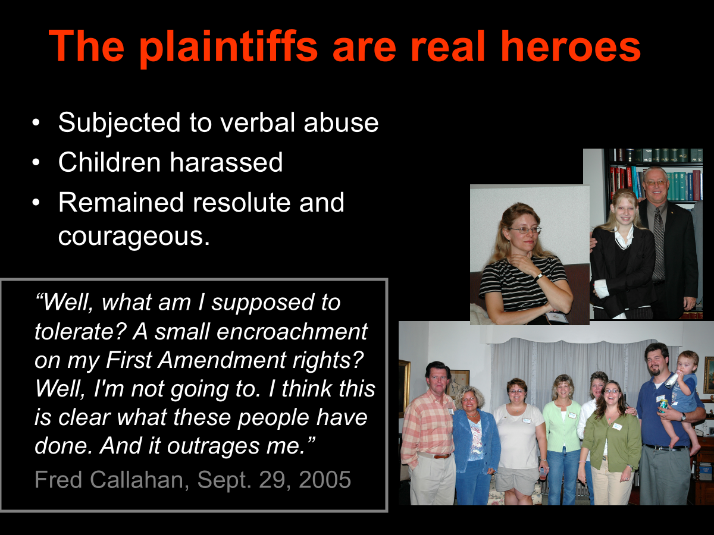
Our clients, most of whom grew up in this rural area, were not prepared for the harassment and vitriol they experienced from people they thought they knew and people they grew up with. It was painful for the lawyers to watch, but we had little recourse with the court. The problem wasn’t the defendants – it was their community supporters. But our clients held strong. One even ran for school board and he and his pro-science slate won election while we awaited the verdict.
On the other hand, the defendant school board members who took the witness stand did themselves no favors. It became painfully obvious during trial that several had lied at their depositions. At the close of one trial day, the judge personally cross-examined the leader of the Intelligent Design block and exposed multiple lies. The board member stammered through unpersuasive explanations, and you could hear a pin drop in the courtroom. The judge’s opinion says it best:
“The citizens of the Dover area were poorly served by the members of the Board who voted for the [Intelligent Design] policy. It is ironic that several of these individuals, who so staunchly and proudly touted their religious convictions in public, would time and again lie to cover their tracks and disguise the real purpose behind the [Intelligent Design] Policy."
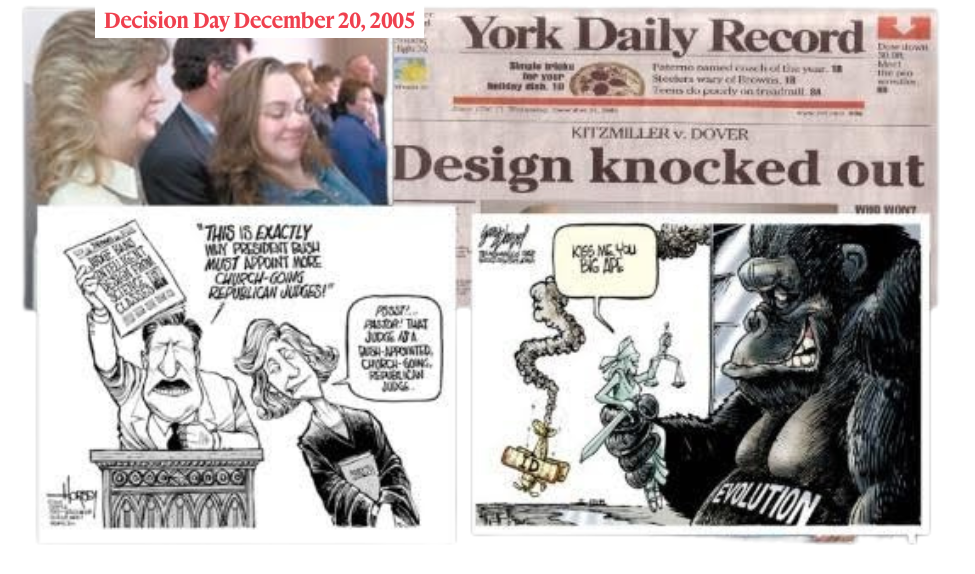
The Decision
The decision, announced shortly before the holiday season, was fantastic. For us. The judge systematically reviewed the evidence and expert testimony, and concluded that, “The overwhelming evidence at trial established that [Intelligent Design] is a religious view, a mere re-labeling of creationism, and not a scientific theory." If it’s simply re-packaged creationism, according to the 1987 Supreme Court ruling, then it’s religious and can’t be taught as science. That’s a violation of the First Amendment’s Establishment Clause, our freedom from religion safeguard. Boom. Game over.
It's wonderful to look back on this historic trial, but it foreshadowed some important and highly disturbing trends. Perhaps most notably, the demonization of science itself. False narratives propagated by elected officials to advance personal agendas, which are neither inclusive nor democratic, are dangerous. As is the willingness to brazenly lie and deceive to advance the agenda. We are witnessing all of this in real time, to the detriment of liberal democracy. Our leaders must do better. And the ACLU of Pennsylvania will always be ready to hold them to account.
Postscript
Having heard the Boss play a mid-80’s B-side single during the 2005 concert in which he mentioned the Dover case, I had to play “Part Man, Part Monkey” every morning before going to court. It’s a tongue-in-cheek song about the Scopes monkey trial. At first my colleagues and clients thought me forcing everyone to listen to the song before going to court every morning was cute, but by the end of the trial I was usually walking alone. I managed to inject that story nugget into a Rolling Stone article about the trial and then to parlay that into a couple of backstage visits with Bruce.
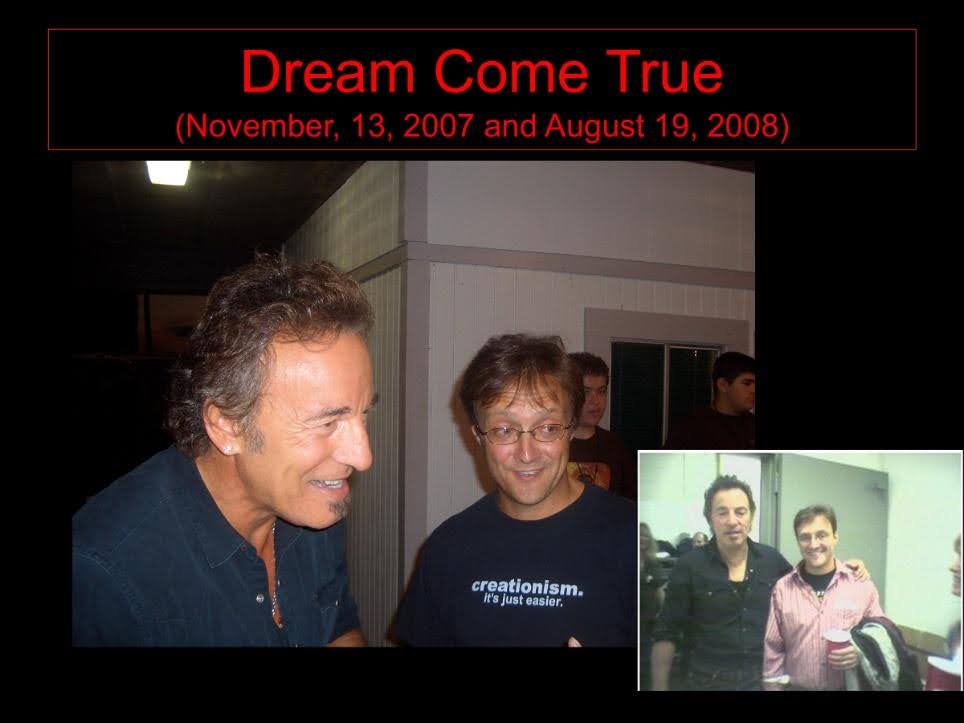
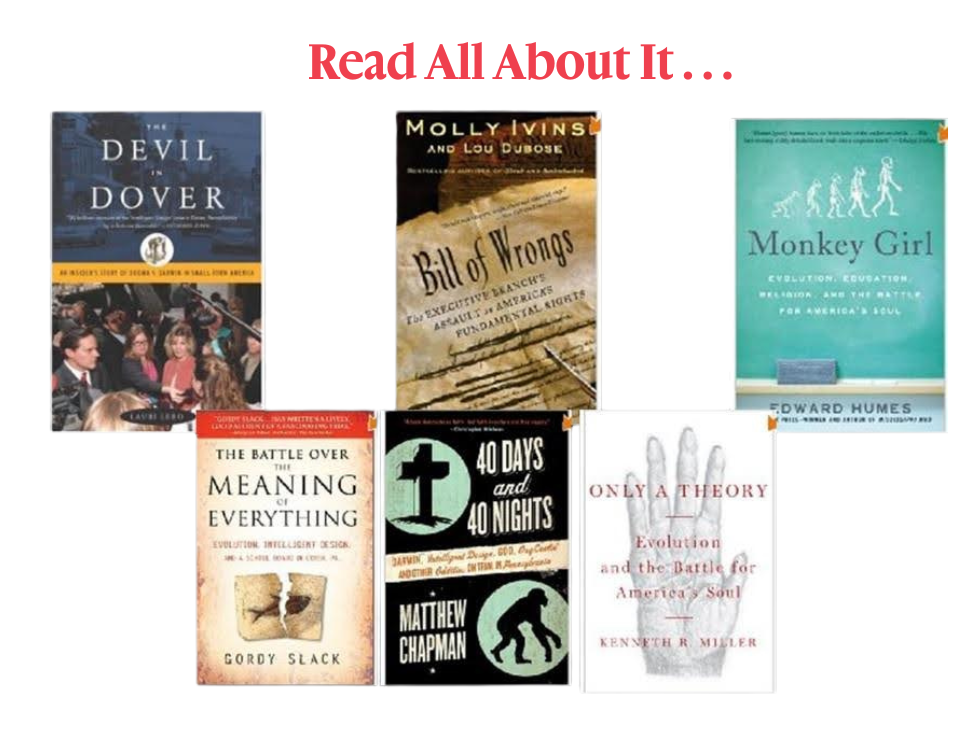
During a second backstage visit with clients, lawyers and others, we gifted him with the book, Devil in Dover, by local author Lauri Lebo. After noting how impressed he was that it was endorsed by Howard Zinn, a favorite of his, he asked what he could do for us, to which we said, play Part Man, Part Monkey! He definitely wasn’t ready to play it, saying some newer members of the band didn’t even know it. But then he asked who, if he were to play it, would he dedicate it to. We arrived at, “Dover parents and good science education.” Reluctance and absence of any rehearsal aside, Bruce played the song! He made the agreed dedication, but ad-libbed “all to the glory of God.” Indeed.
Related Content
Kitzmiller v. Dover
PA Parents File First-Ever Challenge to 'Intelligent Design' Instruction in Public School
A Relatively Brief History of the ACLU of Pennsylvania