
Get the Flock Out of PA
Last updated on October 19, 2026
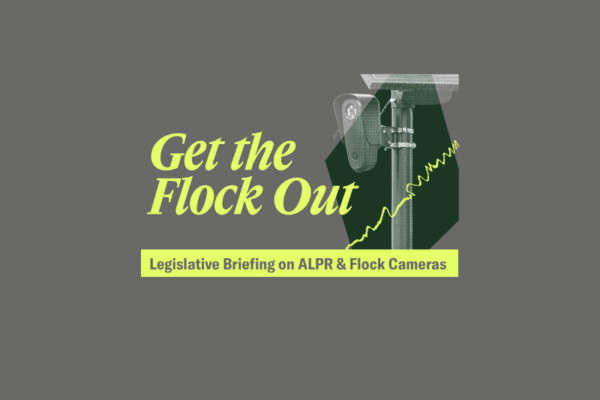
Automatic license plate reader (ALPR) cameras are rapidly being installed throughout Pennsylvania but are virtually unregulated in our state. Many ALPR cameras, such as those made by the brand Flock Safety, are continuously collecting data that can be kept and accessed by law enforcement agencies across the country. In short, our daily movements are being tracked as we travel throughout the state.
Learn more about ALPR cameras and what you can do to help protect privacy in our communities.
FAST FACTS
- 140,000 | Over 140,000 ALPR cameras are deployed nationwide by over 6,000 agencies
- 9th | Pennsylvania has the 9th-largest documented total of ALPR cameras in the U.S.
- #1 | Allegheny County and Pittsburgh have the highest number of ALPR cameras among PA counties and cities
The Problem
ALPRs were sold to American communities as a targeted tool for catching car thieves, finding missing people, and solving major crimes. But evidence for these claims is thin. In fact, a recent study in Atlanta found that despite an eightfold increase in the number of cameras integrated into the city’s surveillance program, clearance rates by the Atlanta Police Department for crimes like homicide, robbery, miscellaneous larceny, and shoplifting actually decreased between 2021 and 2025.
Instead, what American communities bought was an expansive form of surveillance technology that captures the movements of every driver who passes, regardless of whether they are suspected of any crime. Thousands of communities are now blanketed with ALPRs, quietly assembling powerful mass surveillance systems that can reconstruct where people have been, when, and how often, all without a warrant.
Creating patterns of behavior, ALPR data can reveal intimate details about a person’s life, including their religious practices, medical visits, political activities, personal relationships, and daily routines. This dragnet surveillance threatens the freedoms the Fourth Amendment was adopted to protect. These concerns aren’t just abstractions—every day, innocent people are harmed by officials’ abuse and misuse of these ALPRs.
ALPRs have been used by federal, state, and local agencies to identify and track:
- Immigrants by ICE
- Protestors by over 50 federal, state, and local agencies
- Op-ed writers by local police
- Gun show attendees by the DEA and ATF
- Abortion care seekers by state and local police
- Ex-partners stalked by police officers
The Solution
ALPRs can be beneficial when used for law enforcement purposes, such as identifying a vehicle that has been reported as stolen or involved in a crime or locating a missing person. Those activities, when used appropriately and with clear safeguards, can be a reasonable use of the technology. However, without strict use limitations and short retention periods, this data can quickly become a tool for broad, ongoing surveillance across our communities.
OPTION 1: BAN ALPRs
Although an ALPR ban may seem bold, given the increased public outcry and aversion to mass government surveillance coupled with rampant documented abuses of ALPR data, some lawmakers have decided that the paltry benefits of ALPRs do not justify the threats to their residents’ privacy rights.
- Statewide ALPR bans: In August 2026, both Florida and Texas each banned the use and funding of ALPR cameras by the state. And effective July 1, 2027, Vermont’s authorization of ALPRs will sunset, triggering an ALPR ban for all towns, cities, and state agencies.
- Local ALPR bans: Across the United States, hundreds of municipalities have decided to cancel, reject, or deactivate their Flock/ALPR contracts.
OPTION 2: ESTABLISH STATEWIDE ALPR GUARDRAILS
State law should establish clear and consistent ALPR rules and guardrails. When localities are tasked with establishing their own ALPR rules, civil rights and civil liberties protections will be uneven and can be inadequate.
To avoid a patchwork of ALPR regulation, state law should—at a minimum—establish a baseline for data retention, data access, and database use for the commonwealth. Localities should be free to impose additional limitations or restrictions—including bans—on ALPRs in their communities.
Below are three critical guardrails that any privacy-protective legislation should include when regulating ALPRs:
1 | Data Retention Limits: The more ALPR data that is captured and the longer it is retained, the more private information it reveals. ALPR data can be run against hotlists in a matter of seconds, which makes a long retention periods unnecessary. When data is found to be relevant to an ongoing criminal investigation, that data can be retained longer in order to permit law enforcement to obtain a warrant for the data.
- Solution: Significantly limit ALPR data retention unless linked to a specific investigation. 48 hours is more than enough time to retain license plate data that is not connected to a crime.
2 | Data Access Restrictions: Without restrictions on who can access and share data, ALPR data can be made available to unknown and untrusted recipients. The greatest impact of Flock’s growing dominance of the ALPR market is that Flock’s nationwide data sharing model has made local ALPR data available to virtually any law enforcement entity who wishes to access it.
- Solution: Prohibit data sharing outside of the collecting department unless the requestor has a judicial warrant. Alternatively, limit ALPR data sharing to only PA state and local entities, unless the requesting entity has a warrant for a crime recognized in PA.
3 | Database Use Restrictions: ALPRs can be used to target disfavored and vulnerable groups, for minor crime enforcement, and to generate suspicion out of thin air.
- Solution: Limit use to only the worst crimes (e.g., kidnapping) and prohibit inappropriate uses (e.g., identifying protestors).



Related Issues
Related Content

ACLU-PA Statement on Passage of Privacy Protection Law for Flock-Style Cameras