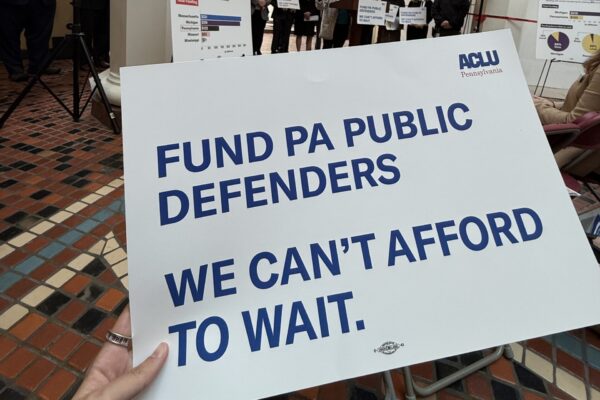

Few people ever imagine that they will need a public defender. It’s a constitutional promise that sits quietly in the background; it’s an emergency protection most of us never consider until the unthinkable happens and everything is at stake. Your home, your job, custody of your children, your life and freedom are all placed on the line as you wait for your day in court, hopefully with effective legal counsel arguing in your defense.
With 1.46 million Pennsylvanians living below the federal poverty line and nearly 40% below the ALICE threshold (Asset Limited, Income Constrained, Employed), the reality is that in every corner of our state, countless people live only an accusation away from wishing our public defense system were better. Charges that could put a person’s life and liberty in jeopardy could be as simple as a traffic offense or disorderly conduct; yet the consequences for Pennsylvania residents would still be grave, namely, sitting in a jail cell.
The right to counsel when you are deemed “indigent”—a person who cannot afford a private attorney—is a safeguard of fairness. In our adversarial system of law, true justice requires the scales to be balanced between the prosecution and the defense. Rather than treating public defense as an abstract guarantee, we should see it as a standard communal good, like an insurance policy, or the taxes that fund libraries, trash collection, and emergency responders. If the time comes that you need public defense against criminal charges, it should be available as one of our vital public services.
Instead, public defenders are perpetually neglected by our criminal legal system. Often left to fend for themselves, they are stretched impossibly thin, underfunded, underpaid, and rarely acknowledged for their invaluable service. Pennsylvania ranks among the worst in the nation for public defense funding, largely because the state has offloaded all responsibility for funding and managing public defender offices onto the counties. This signals to our communities that lawmakers do not value the effective functioning of our legal system—or our constitutional rights to a fair and speedy trial and the presumption of innocence. Simply put, the way Pennsylvania funds public defense betrays our state and federal constitutions.
Champions like former Luzerne County Chief Public Defender Albert “Al” J. Flora, Jr., saw the overwhelming pitfalls of our public defense system. But rather than being a silent, compliant participant, he decided to demand change.

A photo of Luzerne County Chief Public Defender Albert “Al” J. Flora, Jr.
©Marco Calderon Photography
Continuing Behind a Trailblazer for Public Defense
Remembering public defense champions like Al Flora on National Public Defender Day is important. It reminds us of why this fight matters, how the horrors of our current system ripple through our communities, impacting those accused, victims, families, and the very public defenders who, most of the time, are running on coffee and willpower just to attempt to do their job effectively.
This day honors and occurs on the anniversary of the landmark 1963 Supreme Court decision, Gideon v. Wainwright, but it is dedicated to heroes like Al Flora, unsung defense lawyers who strive to make the guarantee of the Gideon decision tangible for the people who call Pennsylvania home.
A few weeks ago, I learned of Al’s passing at age 75. Al was a first-rate lawyer and an even better human. For decades, he was a leader in this fight. He tried to rebuild the Luzerne County Public Defender’s Office after the horrific so-called Kids for Cash scandal, in which thousands of children were tragically victimized by a corrupt legal system. We entered the fray after Al reached out to me at the ACLU of Pennsylvania for help. He had way too few attorneys and staff to provide constitutionally required criminal defense representation to many of his clients; there simply weren’t enough hours in a week for his tiny staff to interview clients in a timely way, investigate the facts, prepare motions, and appear in court. And he knew it.
Al’s predicament as a public defender wasn’t that unusual; many, if not most, public defenders in Pennsylvania and other states face the same plight: too many clients and not nearly enough resources to do what the Constitution requires. What made Al special was his willingness to fight his employer, Luzerne County, to fix the problem, knowing it could cost him his job and affect his career.
Public Defense Champion Albert “Al” J. Flora, Jr.
Photo credit: ©Marco Calderon Photography
As Al was showing me around the little public defender’s office in Wilkes-Barre on my first of many visits, I raised with him the perils of suing his employer. He was resolute. His focus was on both ensuring that people criminally charged received the representation they deserved under the Sixth Amendment, but also on the impact the overwhelming caseload had on his staff, many of whom were just starting careers and trying to raise families.
The ensuing lawsuit in 2012 was captioned Kuren v Luzerne County, after a public defender client, but it was Al’s leadership that drove the litigation and saw it through. The case produced a seminal Pennsylvania Supreme Court opinion establishing that the courts have the authority to decide lawsuits challenging the constitutional adequacy of public defender offices in a systemic manner.
Now in 2026, the ACLU of Pennsylvania is back at it, knee deep in a decades-long fight for the right to representation in criminal cases, challenging the Commonwealth of Pennsylvania to redesign our public defense system so that it shows up for Pennsylvanians the way that our Constitution intended. The case, Warren v. Commonwealth, was filed in 2024 and argues that under the Sixth Amendment, the state cannot simply absolve itself of responsibility for providing an effective public defense system. Warren builds on Al’s case, asking the court to order the commonwealth, specifically Governor Shapiro and the General Assembly, to dramatically overhaul how Pennsylvania supports public defender offices statewide by increasing funding to a constitutionally acceptable level.
County by County, State Lawmakers Are Failing Our Communities
The quality of legal representation offered by public defenders in the commonwealth comes down to how much funding they receive from their county.
That means someone arrested in a county that provides more funding for public defenders could be out of jail in just a day or two. If that same person were arrested for the same crime and qualified as indigent in a county with inadequate funding for public defense, they might find themselves behind bars for months—sometimes over a year—before a defender is able to get to their case.
Our constitutional rights are sacred; they are not malleable or negotiable depending on a person’s geographic location. Or the size of their wallet or pocketbook. But in Pennsylvania, that’s exactly what’s happening. The extent to which a person can access their Sixth Amendment rights depends on their zip code and their finances.
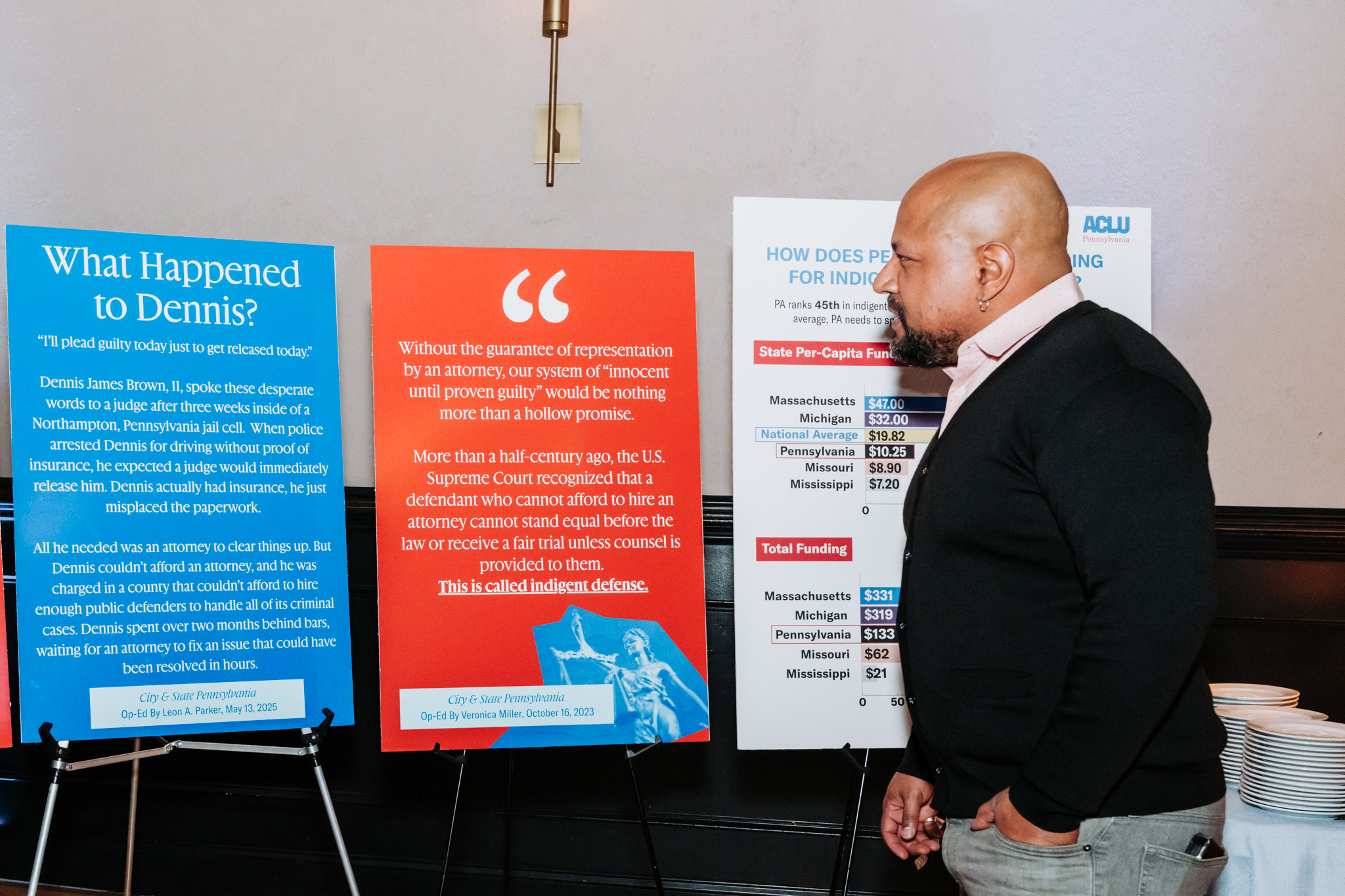
A photo of a person looking at a public defense posterboard display.
Gregory Wright
In Bedford County, the lone public defender handles approximately 250 to 300 adult criminal cases, a combination of felonies and misdemeanors, about 100 juvenile cases, and a number of supervision revocations and direct appeals.
Fayette County has just one full-time attorney, its chief public defender, and employs just seven part-time attorneys to handle a caseload of more than 1,700 cases.
In Northampton County, people accused of a crime who cannot afford a private attorney regularly plead guilty moments after their first and only conversation with a “standby” attorney. These “standby” attorneys are present at formal arraignments to help facilitate unrepresented, typically indigent, defendants’ guilty pleas. One person who pleaded guilty in June 2023 described his 30-second interaction with a “standby” counsel as akin to a “fast food” restaurant.
Since 2022, chief public defenders in Erie, Franklin, Lebanon, and Luzerne counties have even attempted to stop taking on new cases because they are so understaffed that their attorneys cannot effectively represent additional clients.
These are just a few examples of how Pennsylvania’s public defense funding crisis plays out in our own backyard.
From Gideon to Warren: The Road to Realizing the Sixth Amendment
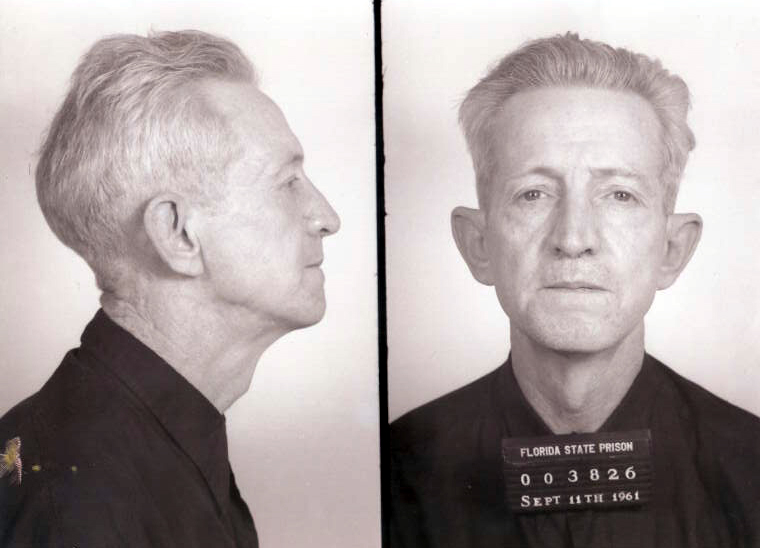
An archive photo of Clarence Earl Gideon.
In 1961, Clarence Earl Gideon was charged with breaking and entering and intent to commit petty theft at a pool hall in Panama City, Florida. At his trial, Gideon was unable to afford a private attorney and requested that the court provide him with counsel, as guaranteed by the Sixth Amendment. However, Florida law at the time mandated that courts could only appoint counsel in death penalty cases. As a result, the court refused Gideon’s request for counsel.
Gideon ultimately defended himself. He was found guilty and sentenced to five years in prison. While incarcerated, Gideon used legal resources he was able to access in prison and crafted an appeal to the United States Supreme Court. Gideon argued that the lower court had violated his Sixth Amendment rights when it failed to appoint an attorney to defend his case. At the Court’s request, the ACLU stepped in to argue Gideon’s case. In a unanimous decision, all nine Supreme Court justices agreed that Gideon’s constitutional rights had been violated. The case, Gideon v. Wainwright, set the modern-day legal precedent across the country that every single person charged with a crime has the right to an effective and well-resourced conflict counsel. Upon retrial, this time with a lawyer, Gideon was acquitted.
But constitutional rights are only as good as their implementation – more than fifty years later, Gideon’s promise remains unfulfilled, so we continue the work.
Our lawsuit, Warren v. Commonwealth, is ambitious because the systemic problem is more entrenched than many of us can fathom. What should the constitutionally adequate price tag be for a proper public defense system? We believe the state should budget around $50 per Pennsylvanian. That sounds reasonable, when people pay more than that to fill up a gas tank. But Pennsylvania is so far behind, almost dead last among other states, that the $50 equates to Pennsylvania investing upwards of $600 million over the next several years to sufficiently resource public defenders in each of the commonwealth’s 67 counties.
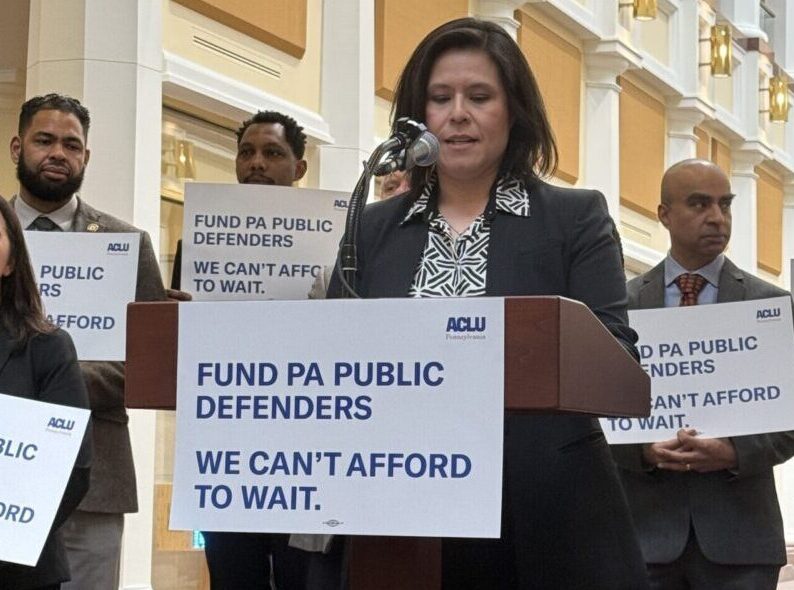
The ACLU-PA's Veronica Miller addresses the public about public defense funding with coalition partners beside her.
Of course, lawsuits take time. We anticipate that litigation in Warren will likely last for years before we get a final decision from the courts. The good news is, Governor Shapiro and Pennsylvania state lawmakers could take action today to address this crisis without waiting for a court order.
And more good news: both the governor and some state legislators have taken small steps toward addressing the huge funding shortfall. In his 2023-2024 budget proposal, for the first time ever, Governor Shapiro included $10 million in funding for public defense, and the Pennsylvania legislature ended up approving $7.5 million of the proposal. This signals a commitment to solving the problem, but 7.5 million is a tiny fraction of what we need (1.25% to be exact).
So even as our case makes its way through the courts, we are beating the drum through advocacy efforts, in partnership with other criminal legal reformers across the state, to push the governor and state lawmakers to continue incrementally increasing the annual budget for public defenders. We know it will be a long journey, but each year that passes must move us closer to where we need to be in terms of adequate funding and resources for public defense.
The Fight for Adequate Public Defense Won’t Be Easy
For Al’s tenacity and bravery, he was indeed fired by Luzerne County. When Al learned that the county was playing games with court-ordered reporting on the Kids for Cash victims, he blew the whistle. And the county retaliated. While we won a handsome settlement in a First Amendment retaliation lawsuit for Al a few years later, the episode ended his tenure as a public defender, showing that every battle has its upsets and setbacks, even when it ultimately leads to a victory. Despite the hurdles we will undoubtedly face, the ACLU is committed to this vitally important struggle for as long as it takes. We have been playing the long game for over one hundred years, so we know what it takes to secure civil liberty wins.
As for Al, he will be missed, but his deeds are already recorded in history. On this Public Defender Day, we honor Al Flora and his legacy by saying rest in peace, our friend. Your memory and spirit will fuel us as we continue to fight for the public defense system Pennsylvanians deserve.